Irish Abroad
Perhaps a letter in your family names a town in Ireland. Perhaps you teach Irish history in Boston, Berlin or Melbourne. A place name gives us somewhere to begin. Here is how we follow one through the Library.
Begin with the name on the page
Write down the spelling exactly as you found it, including any abbreviation. Beside it, note who wrote it, when, and whether they were writing from the place or remembering it later. Keep a second column for other spellings you encounter.
Try it with Rathangan
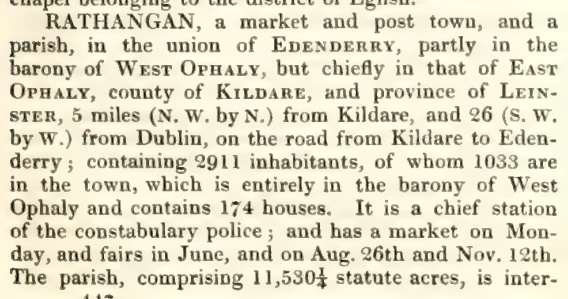
Open page 447 of Samuel Lewis’s A Topographical Dictionary of Ireland, published in 1847. Find Rathangan at the foot of the left column. Lewis places the town on the road between Kildare and Edenderry. Could someone reading his book trace that road using his description?
Listen for what the printed page leaves out
In our Nine Mile Road chapter, Biddy Collins recalls stopping along the road and working in the bog. Return to Lewis’s entry after hearing her account. Which details could someone learn only by asking a person who knew the road?
Follow your own place into the Library
If a name brings up nothing, try the county, a neighbouring town, or another spelling from the record. A shared surname or place name is a lead. To establish a family connection, look for a record that links the people themselves.
Bring it to a class or reading group
Choose one line from the printed record and one detail from the account. Keep the writer’s name and page number beside the first, and the speaker’s name and recording title beside the second. Ask someone else what they notice when they read the two together.
Continue with the Irish Studies reading exercise · Plan a class with the Foundation