Read the papers that made it possible to survey, claim and redistribute land in Ireland. A demand sent to the Crown, a map drawn for its officers and a witness named in an index each give us a different way into that history.
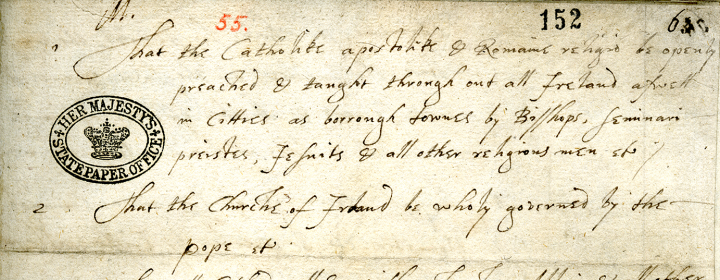
Hugh O’Neill · November 1599 · The National Archives, Kew · SP 63/206, document 55
Detail of the first two items · The National Archives, SP 63/206
The English state papers also preserve demands made of the Crown. This image shows the first two items in O’Neill’s list of war aims. Start by asking whose position the paper records and how it came to sit in an English government collection.
The National Archives, UK · State Papers Ireland. Source recordWhose words are these?
The archive that holds a document and the person whose demands it records can be different. Here the Crown’s papers preserve O’Neill’s negotiating position.
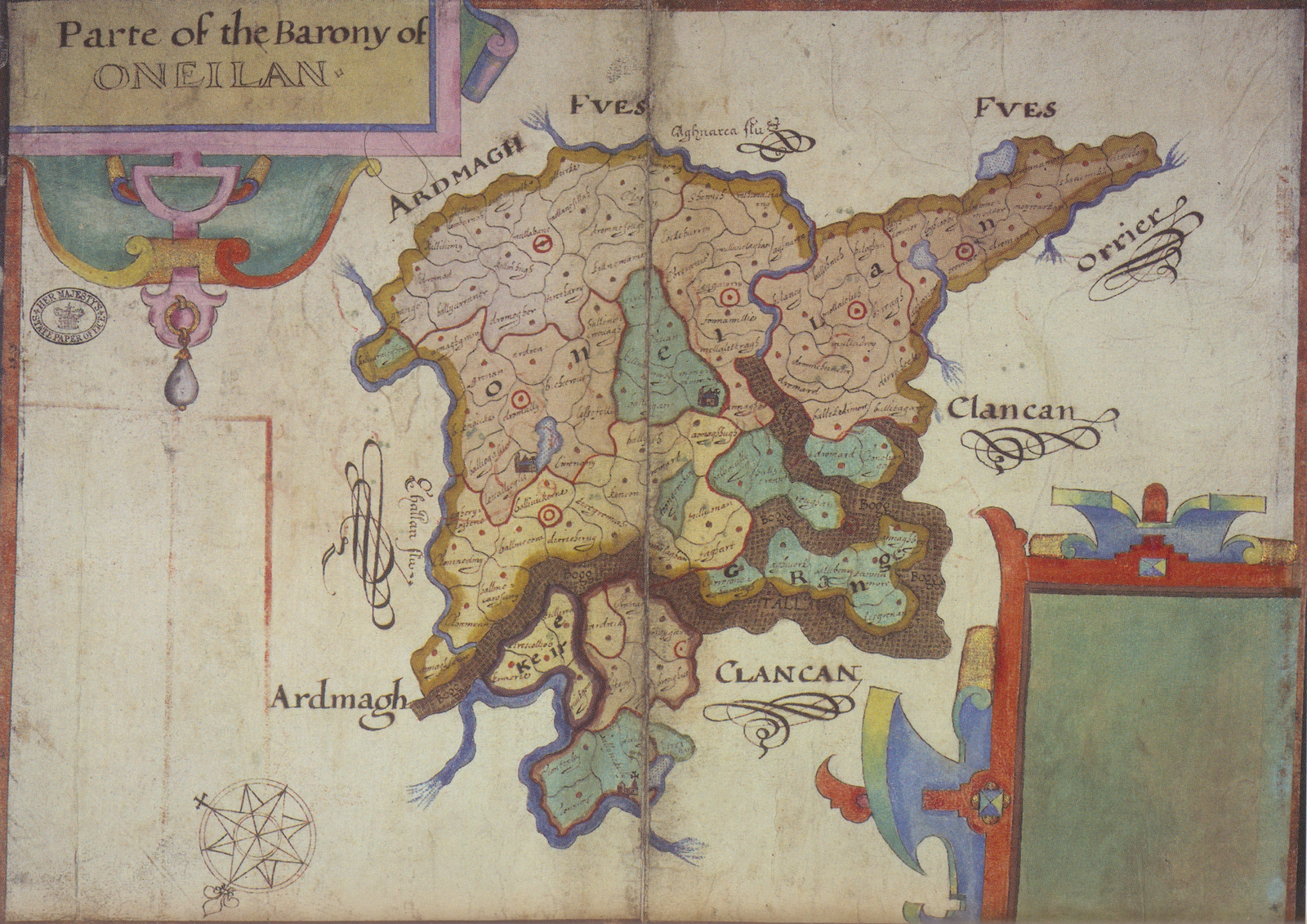
Josias Bodley · Ulster survey, 1609 · The National Archives, Kew · MPF 1/61
Josias Bodley’s map · The National Archives, MPF 1/61
Look closely at a place-name in Oneilland. What did the surveyor need to record so that someone elsewhere could allocate land? The drawing gives us the surveyor’s view. A family’s claims to the same ground might have been expressed in quite different ways.
Map reproduced in Plantation Ireland, plate 6 · digital copy via Wikimedia Commons. Source recordWhere is Oneilland?
Oneilland is a barony in County Armagh. A barony is a division of a county. Pick one name on Bodley’s map and see how much of the ground around it the surveyor chose to draw.
Sir John Davys · 1609 letter · printed in the Ulster Journal of Archaeology, 1856, pp. 192–197
“assure this whole Iland to the Crowne of England for ever”
Sir John Davys · letter of 1609
Davys describes an inquest into land and the effort to persuade London investors to join the plantation. Read his account of the jurors and then his account of the investors. Who gets to decide what the land is worth? The letter begins on the third PDF page.
On the last page, Davys gives his reason for encouraging the Londoners. He sees their plantation as a way to secure the Crown’s hold on Ireland. That is a political aim, written down by one of the men charged with making it happen.
Public-domain scan of the 1856 edition · historical reference given there as State Paper Office, Irish, June–December 1609, no. 122. Source recordWho was the letter written for?
Davys was reporting on the Crown’s work in Ireland. Read his case for bringing Londoners into the plantation alongside the proposal the London companies received.
Trinity College Dublin, MS 832 · 1641 Depositions, vol. II, Cavan and Fermanagh · principal editor Aidan Clarke · Irish Manuscripts Commission, 2014
The opening pages of the Cavan volume arrange names beside alleged offences and witnesses. Follow one entry across the columns. An accusation in this index is evidence of what was recorded. Establishing what happened requires following the testimony behind it.
Irish Manuscripts Commission · published sample, including the opening of MS 832. Source recordWhat is a deposition?
A deposition is a statement given as evidence. In this printed index, a witness and the person accused occupy different columns. Read the column headings before drawing a conclusion about either name.
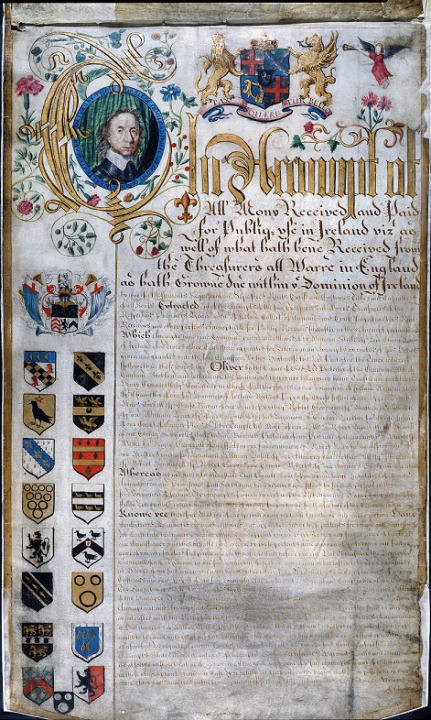
Accounts of public money for use in Ireland · The National Archives, Kew · SP 63/281, folio 1
Opening folio · The National Archives, SP 63/281
Start with the portrait of Oliver Cromwell and the emblems down the margin. An account book can tell us how authority presented itself as well as how money was recorded. This opening folio lets us study the first question; a calculation of expenditure would require the entries that follow.
The National Archives, UK · State Papers Ireland. Source recordWhat is a folio?
A folio is a leaf of a manuscript. This is the opening leaf of the accounts. Look at the portrait and the emblems before turning to the separate question of how the money was spent.
What makes a road worth recording? Samuel Lewis needed his readers to find Rathangan. Biddy Collins remembered where families stopped between Rathangan and Edenderry, and the work they did there.
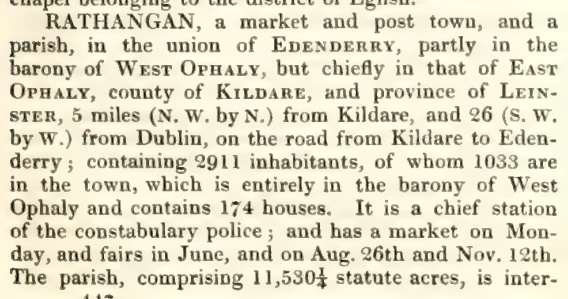
The printed record · 1847
Rathangan in Lewis’s dictionary
“on the road from Kildare to Edenderry”
Lewis locates the town by the road, counts its houses and gives Monday as market day. Look at the foot of the left column for Rathangan. The entry continues at the top of the right column.
Samuel Lewis, A Topographical Dictionary of Ireland, second edition, volume II. S. Lewis and Co., London, 1847, p. 447.
Pavee Roads Home · project photographer Derek Speirs
“we used to work in the bog, we’d call it footing turf.”
Listen for the name she gives the road and for the wagons she remembers. Footing turf meant standing the cut pieces together so they could dry. Her account puts the families and their work back into the description of this place.
Read Biddy Collins’s account
“This is the 9 mile road from Edenderry to Rathangan and we used to stay along here many years ago and we used to work in the bog, we'd call it footing turf. Where all the Travellers used to foot the turf in the bog. And we used to stay along here on down there one place or another there was no trailers that time only wagons.”
Biddy Collins, The Nine Mile Road, Pavee Roads Home, Edenderry Oral Histories Map. Map published 4 September 2020. Recording date unlisted.
Where were you when Offaly played Down? James Collins could have answered that question down to the cottage. His family was camped at the head of Tubberdaly when the battery in their wireless went flat.
The historical record
A townland name and a Sunday fixture
“Typerdely”
That is how the name appears in a record from 1238. You can follow it in the Placenames Database of Ireland under Tobar Dálaigh or Toberdaly. On the Edenderry oral-history map, look for The head of Tubberdaly.
Calendar of Documents Relating to Ireland, volume I, p. 368, as indexed by the Placenames Database of Ireland.
Pavee Roads Home · project photographer Derek Speirs
“that man had an electric wireless that you could hear back on the road”
Listen for the moment he leaves the camp and runs to the cottage. You can hear how much the match mattered to him in the way he remembers a penalty still being argued over a year later.
Read the wireless passage
“The battery went flat of the old time wireless and we ran on to that cottage, that man had an electric wireless that you could hear back on the road I'll never forget that till the day I die.”
James Collins, The head of Tubberdaly, Pavee Roads Home, Edenderry Oral Histories Map. The map was published on 4 September 2020. The recording date is unlisted.
Start with a rule about who could rent land. Follow it into Tyrone, into the meeting rooms of London and back to a castle in Cavan. Along the way, look for the people the papers name and the families they describe in a few words.
Each PDF is a page from George Hill’s 1877 Belfast edition of the plantation papers. The quotations follow the printed transcriptions. Hill’s numbered footnotes are his own commentary.
Crown plantation conditions · in circulation by March 1609
Who could rent the land?
Original words
“shall not alien or demise their Portions”
In plain English
Article 7 tells English and Scottish grantees whom they could sell or lease land to. Read on to the words “meer Irish”. That was the government’s label for Gaelic Irish people. Here it had a practical consequence. A family could be barred from renting the ground it knew, even if the new landlord wanted it to stay.
Look at the numbers beside those words. The commissioners proposed thirty-five portions for English and Scottish planters, eleven for Crown servants and eight for local people who would hold land in their own right. These are portions of different sizes. We can see whom the commissioners favoured, but we cannot count displaced families from this table.
Lord Mayor of London to the city companies · 1 July 1609
What did London stand to gain?
Original words
“profitable to the undertakers”
In plain English
An undertaker here was someone who agreed to take on a plantation grant. The mayor asked London’s companies to weigh the proposal. He spoke to them of honour for the city and profit for investors. What would the same invitation have sounded like to a family living on the land being offered?
Follow the fish. The proposal asks the king to buy fishing rights from the people who held them and give them to the plantation towns. A river could be part of the offer just as a field could. The paper names the places and the intended beneficiaries. It leaves the people who held the fishing rights unnamed.
Captain Nicholas Pynnar’s plantation survey · 1618–19 · County Cavan
Who was still living at Mullagh?
Original words
“the land is now inhabited with Irish”
In plain English
At Mullagh the survey names the men who held the grant, describes repairs to an old castle, then records the Irish people living there without naming a single household. Look at the little word “but” just before the passage. It tells us something about the inspector’s expectations. The residents’ names and their accounts would have to come from elsewhere.
Start with the kind of work you want to hear. A scholar can also be a storyteller. For work written together, we credit each author.
Traveller scholarship
Read Traveller sociologist Sindy Joyce alongside her co-authors Amanda Haynes and Jennifer Schweppe. Their study asks what the Irish state’s 2017 recognition meant in law. Published online in 2020 and in Nationalities Papers in 2021.
In Why the Moon Travels, Oein DeBhairduin gathers stories from the Traveller oral tradition. Nan Joyce’s autobiography offers another way in: a life told from within the community, with Anna Farmar credited as editor.
Kristina Varade identifies herself as a member of the settled community in her 2025 essay on Traveller storytelling across books, performance and digital media. Read her interpretation alongside the work of the storytellers she discusses.